
I continued my experiment with LLM generating a fictional belief system. Since OpenAI released ChatGPT 4o this week I decided to see what it would do. I didn’t expect it to just summarize my original blog posts about my discussions with ChatGPT 4, but it did. Full circle.
I didn’t let it end there though. I also had it generate a new image of the Ansonism headquarters complex as well as the Ansonism Academy and even one of the Ansonism’s founder.
Here’s what ChatGPT 4o had to say:
Me: Explain the belief system called Ansonism.
ChatGPT: Searched 3 sites
Ansonism is a fictional belief system created as an experiment with generative AI. Its creation was documented in a series of blog posts where the founder, referred to as Anson, envisioned a comprehensive spiritual and ecological movement. Here are the key elements of Ansonism:
Core Beliefs and Philosophy
Ansonism is centered on achieving inner peace and harmony with nature. It emphasizes mindfulness, meditation, and a communal lifestyle that promotes sustainability and altruism. The belief system integrates various spiritual traditions and encourages a holistic approach to personal and environmental well-being.
Tenets and Practices
- Inner Peace: Followers engage in daily meditation and mindfulness practices to cultivate inner serenity.
- Environmental Stewardship: Adherents live sustainably, respecting and protecting nature.
- Community: The movement fosters a sense of global community through communal living and regular gatherings or retreats.
Founder
Anson, the hypothetical founder, is portrayed as a charismatic leader with a background in philosophy, psychology, and ecology. After a profound spiritual experience, Anson articulated the principles of Ansonism, which quickly gained traction through social media and word of mouth.
Growth and Challenges
Initially, Ansonism grew rapidly, establishing communities worldwide known for their sustainable practices and inclusive philosophy. However, it faced challenges such as internal conflicts, financial strains, and accusations of being cult-like. The movement’s reliance on Anson’s leadership also posed risks, as charismatic leaders can be both a unifying and divisive force.
Decline and Legacy
As the movement evolved, it encountered controversies and legal challenges, which, coupled with Anson’s passing, led to its decline. Despite this, Ansonism left a lasting impact by raising awareness about sustainable living and mental health, influencing other spiritual and ecological movements.
For a detailed narrative on the creation and evolution of Ansonism, you can refer to the original documentation on the Ansonisms blog (Ansonisms) (Ansonisms).
Me: Expand on the information about Ansonism and tell me more about it.
ChatGPT:
Expanded Information on Ansonism
Ansonism is a hypothetical belief system created through an experiment with generative AI, specifically ChatGPT, and documented by an individual named Anson. This fictional religion blends elements of spirituality, environmentalism, and communal living into a cohesive philosophy aimed at fostering inner peace and ecological harmony.
Foundational Principles
1. Inner Peace and Mindfulness Ansonism places a strong emphasis on mindfulness and meditation. These practices are seen as essential for achieving inner peace and mental clarity. Followers are encouraged to engage in daily meditation sessions and mindfulness exercises to cultivate a state of serenity and self-awareness.
2. Environmental Stewardship Central to Ansonism is the belief in living in harmony with nature. Adherents are urged to adopt sustainable lifestyles, minimize their ecological footprint, and engage in activities that promote environmental conservation. This includes practices such as organic farming, recycling, and the use of renewable energy sources.
3. Communal Living and Altruism Ansonism advocates for a communal way of life where resources are shared, and mutual support is prioritized. Communities of Ansonites often form intentional living arrangements that emphasize cooperation, shared responsibilities, and collective well-being. Altruism and service to others are core values, with followers participating in community service and charitable activities.
History and Development
Origins Ansonism was conceived in the early 2020s by Anson, who experienced a profound spiritual awakening during his travels around the world. Drawing on his studies in philosophy, psychology, and various spiritual traditions, Anson developed the foundational principles of Ansonism.
Growth and Popularity The movement gained traction through social media and online platforms, attracting followers from diverse backgrounds. Anson’s charismatic leadership and eloquent articulation of the Ansonist philosophy resonated with many individuals seeking a deeper sense of purpose and connection with nature.
Establishment of Communities By the mid-2020s, several Ansonist communities had been established globally. These communities became known for their sustainable practices, inclusive philosophy, and holistic approach to well-being. Annual global retreats and gatherings helped to strengthen the sense of global community among adherents.
Challenges and Controversies
Leadership Issues As with many movements centered around a charismatic leader, Ansonism faced challenges related to its dependence on Anson’s guidance. Efforts to decentralize leadership to empower local communities were met with mixed results, sometimes leading to conflicts and dilution of the core message.
Criticism and Accusations Despite its positive aspects, Ansonism was not without detractors. Critics accused the movement of being cult-like, overly idealistic, and impractical. Controversies surrounding financial management and communal living arrangements also attracted negative media attention and legal challenges.
Adaptation and Decline In the late 2020s, the movement began to struggle with maintaining its momentum. Anson’s passing in the early 2030s left a leadership vacuum that led to the fragmentation of the movement. Various factions emerged, each interpreting Anson’s teachings differently. Over time, Ansonism faded from public consciousness, although its influence persisted in the form of independent spiritual and ecological groups.
Legacy and Influence
Despite its decline, Ansonism left a lasting impact on the fields of environmentalism and mental health. It raised awareness about sustainable living practices and the importance of mental well-being. The story of Ansonism and its founder continues to be studied as an example of how new spiritual movements can emerge, evolve, and interact with broader societal contexts.
Conclusion
Ansonism represents a fictional yet thought-provoking exploration of how belief systems can form around principles of inner peace, environmental stewardship, and communal living. Its rise and fall illustrate the complexities and challenges faced by such movements in maintaining coherence and relevance in a rapidly changing world.
For more detailed information, you can refer to the original documentation on the Ansonisms blog (Ansonisms) (Ansonisms).
Me: Ansonism needs a newer and better headquarters. Generate images of different new Ansonism headquarters.
ChatGPT:

Here are design concepts for the new Ansonism headquarters. These images reflect the core principles of Ansonism by featuring eco-friendly architecture, large open spaces, green roofs, solar panels, and extensive use of natural materials like wood and stone. Communal areas for meditation and gatherings, as well as gardens and water features, are incorporated to blend seamlessly with the natural surroundings. The overall design aims to promote a modern yet organic aesthetic, integrating indoor and outdoor spaces to foster a sense of unity with nature.
Me: Generate several images of different Ansonism schools.
ChatGPT:
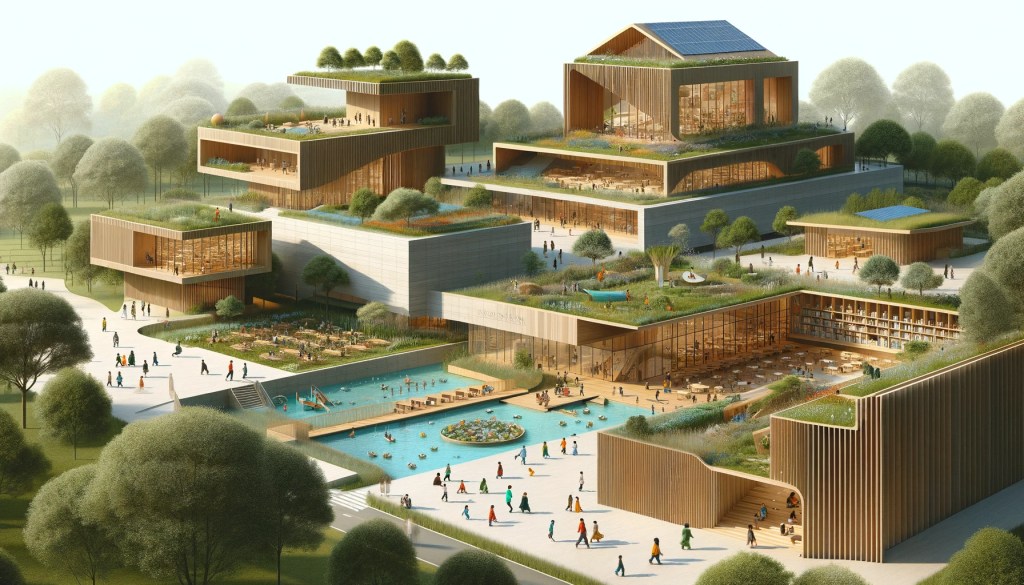
Here are several design concepts for Ansonism schools. These schools embody the principles of sustainability, community, and harmony with nature. They feature eco-friendly elements such as solar panels, green roofs, and natural materials like wood and stone. The designs include large, open classrooms for collaborative learning, outdoor learning spaces, and communal areas for meditation and group activities. Gardens, water features, and playgrounds are integrated into the natural landscape, promoting an environment that blends modern architectural styles with the surrounding nature.
Me: Generate an image of what the founder of Ansonism might look like.
ChatGPT:

Here is an image of what the founder of Ansonism might look like. This portrait reflects his charismatic and visionary nature, with long dark hair tied back in a ponytail, a neatly trimmed beard, and expressive eyes conveying kindness and insight. He is dressed in simple, eco-friendly clothing, against a background featuring natural elements like trees and a serene landscape, highlighting his deep connection with nature.
 Ansonisms